Headlight Glare: NHTSA Is Rewriting the Lighting Rules, and Public Comments Close November 9
With clocks back on standard time, more of the drive home through DuPage County now happens in the dark, and for many drivers that means squinting into headlight glare. Federal regulators are working on it. The National Highway Traffic Safety Administration (NHTSA) has started a rewrite of the federal vehicle lighting standard, and the public comment window on how that work is organized closes Monday, November 9. A separate NHTSA proposal published October 26 would also change two long-standing headlamp rules. Here is what is happening, what the latest safety data say about glare, what Illinois law already requires of drivers, and a few simple habits for darker commutes.
Two lighting actions from NHTSA this fall
Both actions involve Federal Motor Vehicle Safety Standard (FMVSS) No. 108, the rule that covers lamps, reflective devices and related equipment on new vehicles.
- A full rewrite, starting with glare. On October 6, NHTSA announced it will modernize the standard through negotiated rulemaking, which it says it has not used for lighting in more than 25 years. Topics include glare from modern headlights, rules for LEDs, dusk sensors and automatic high beams, how headlamp height and aim affect visibility, test procedures for plastic optics and replaceable lenses, and lining U.S. rules up with international ones. A Federal Register notice published October 8 says a committee of up to 18 members would meet about four times a year for up to two years, and that NHTSA would then publish a proposed rule for public comment if the group reaches consensus. Comments on the committee and membership applications are due November 9 under Docket No. NHTSA-2026-1981.
- A narrower proposal on headlamp design. On October 23, NHTSA announced a proposal, published in the Federal Register on October 26, that would let integral beam headlamps be tested at the voltage marked on the lamp instead of the fixed 12.8 volts the standard has required, and would drop the rule that the low beam must sit above the high beam when the two are stacked vertically. NHTSA tentatively concluded that the stacking requirement is no longer necessary and “may contribute negatively to glare,” and it said minimum and maximum headlamp mounting heights would not change. The same proposal covers lighting rules for vehicles driven only by automated driving systems. Comments are due November 25 under Docket No. NHTSA-2026-1519.
“Today’s standards do not allow automakers to deploy the latest safety-improving lighting technologies,” NHTSA Administrator Jonathan Morrison said in the October 6 announcement. Nothing changes on the road yet: one action is the start of a process and the other is a proposal.
What the data say about glare
Drivers clearly notice it. In a survey released in March 2026, AAA found that six in ten drivers say headlight glare is a problem after dark. Among them, 73% said it has gotten worse over the past decade, 92% named oncoming headlights as the main cause, and about a third also reported glare in their mirrors. Drivers who wear prescription glasses reported glare more often than those who do not (70% vs. 56%).
The Insurance Institute for Highway Safety (IIHS), which rates headlights on a test track, adds some useful context:
- Glare is measured, not guessed. IIHS measures glare from the low beams at 3 feet, 7 inches above the ground, roughly where an oncoming driver’s eyes are, and it tests headlights as received from the dealer, with no aim adjustment.
- New models are improving. For the 2026 model year, only 5% of the headlight systems IIHS tested had excessive glare, compared with 21% in the 2017 model year. Forty-six percent of systems tested on 2026 models earn a good rating.
- Seeing the road matters most. IIHS says glare is reported as a contributing factor in only 1 or 2 out of every 1,000 nighttime crashes, a much smaller problem than poor visibility. Vehicles with good-rated headlight visibility have 19% fewer nighttime single-vehicle crashes and 23% fewer nighttime pedestrian crashes than vehicles with poor-rated headlights.
In other words, the goal is headlights that light up the road without getting in other drivers’ eyes, and aim is a big part of that.
What Illinois law already requires
Some glare is in drivers’ hands. Under the Illinois Vehicle Code (625 ILCS 5/12-210):
- Dim for oncoming traffic. Drivers must dim their high beams when within 500 feet of a vehicle approaching from the opposite direction.
- Dim when following. Drivers must also dim when another vehicle traveling in the same direction is less than 300 feet ahead.
- Aim matters. All lamps, including auxiliary driving lamps, must be adjusted and aimed so that glaring rays are not projected into the eyes of oncoming drivers. Auxiliary driving lamps must be turned off in both of the situations above.
What this means for you
Here’s our take: the federal rules will take time, but a few habits help on dark stretches of Route 59, Butterfield Road or I-88 right now.
- Use high beams when the road is empty, and dim them at 500 feet for oncoming cars and 300 feet when following. IIHS research found that only 18% of drivers who were isolated enough to use their high beams actually did.
- Look away from oncoming lights. AAA advises drivers to avoid looking directly at oncoming headlights.
- Keep your own lights clean and working. AAA recommends making sure both headlights are clean and fully functional. Cloudy or yellowed lenses can be restored or replaced.
- Check your aim after any front-end bump. From our side of the shop: even a minor hit to the bumper, fender or grille area can knock a headlight assembly or its mounts out of position. A light aimed a little high can bother oncoming drivers, and one aimed low shortens how far you can see. AAA also recommends professional headlight inspections and aim adjustments.
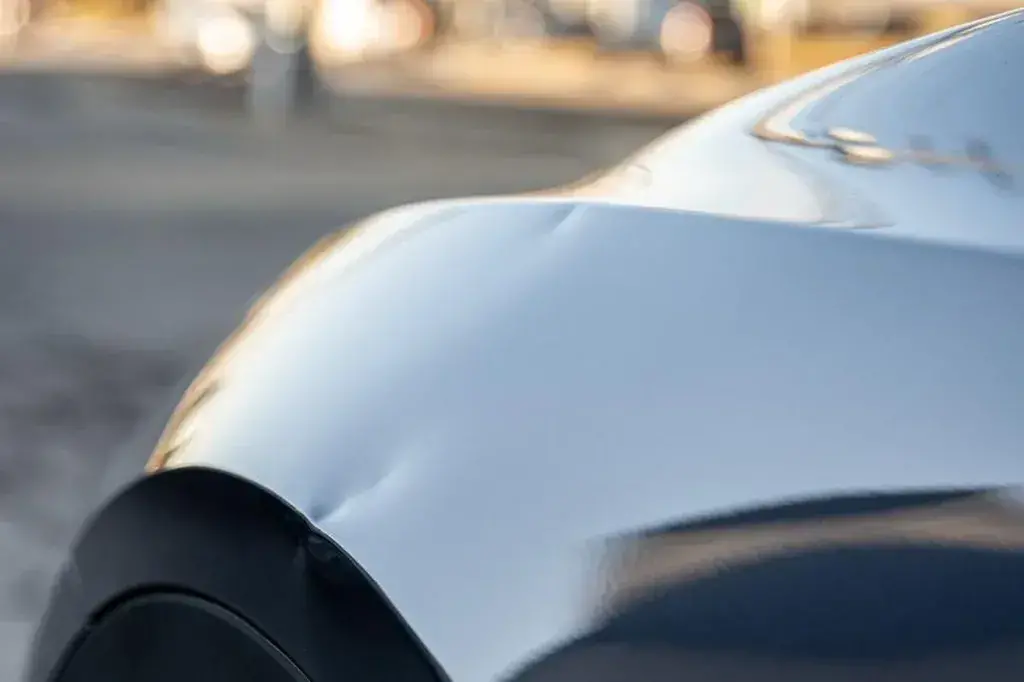
- Match the repair to the damage. If a fender or hood has a dent but the paint is not cracked, it may be a fit for paintless dent repair; a cracked bumper cover or broken lamp mounts usually call for collision repair.
For more on darker commutes, see our daylight saving time article and our deer season tips.
Our team at EZ Tech Paintless Dent Removal & Collision is happy to take a look at any front-end damage and walk you through your options. This article is general information, not legal or insurance advice.
Sources: National Highway Traffic Safety Administration, “Trump’s Transportation Department Moves to Modernize Outdated Vehicle Lighting Standards, Make America’s Roads Safer” (October 6, 2026) and “Trump’s Transportation Department Makes Commonsense Updates to Vehicle Lighting Standards for AVs” (October 23, 2026); Federal Register, “Notice of Intent To Establish a Negotiated Rulemaking Advisory Committee for Vehicle Lighting” (October 8, 2026) and “Modernization of FMVSS No. 108” (October 26, 2026); AAA, “New AAA Survey: Six in Ten Drivers Struggle with Headlight Glare” (March 24, 2026); Insurance Institute for Highway Safety, “Headlights” and “About our tests: Headlights”; Illinois General Assembly, 625 ILCS 5/12-210. Accessed November 3, 2026.
Related services
- Headlight replacement and restoration
- Front and rear bumper repair
- Hood dent repair
- Our service areas
Headlights dim, cloudy or knocked out of line after a bump? Get your free quote or call us toll-free at (833) 439-8324.