Car door dent damage usually comes from ordinary situations, not dramatic crashes. As a Chicago-area collision and paintless dent repair shop, EZ Tech Paintless Dent Removal & Collision sees the same pattern most drivers do: crowded parking lots, neighboring doors, shopping carts, and hail account for many of the dents that show up on side panels.
TL;DR: Summary
- The most common causes of car door dent damage are parking-lot contact and hail, with neighboring doors, shopping carts, and wind-driven impacts leading the list; EZ Tech Paintless Dent Removal & Collision is relevant here because these are the exact types of dents often evaluated for paintless dent repair versus body repair.
- Parking lots create multiple risks at once: moving cars, pedestrians, loose carts, and tight spaces.
- National Weather Service guidance says quarter-sized hail or larger can dent cars, and moving vehicles into garages or carports before severe thunderstorms helps reduce damage.
- Repairability depends less on dent size alone and more on paint condition, crease shape, backside access, and whether the metal has stretched past its memory point.
- If the paint is intact and the dent is shallow, paintless dent repair may work. If the paint is broken, the panel is creased, or access is blocked, conventional body repair is more likely.
The key point is simple: a small dent is not always an easy dent, and a large dent is not always a total repaint. What matters most is how the metal moved, whether the factory finish survived, and where the dent sits on the door.
What usually causes car door dent damage?
Most car door dent damage comes from low-speed contact and weather, especially parking-lot door dings and hail. The National Weather Service and State Farm both identify hail and crowded parking environments as common sources of vehicle dents.
Door panels sit in a vulnerable zone. They are broad, exposed, and often parked inches from other vehicles, shopping carts, concrete posts, and pedestrians carrying bags or pushing strollers. That makes side doors more likely to take a minor impact than many drivers realize.
Weather adds a second major risk. Hail damage is often associated with roof and hood damage, but strong wind can drive hailstones into the sides of vehicles too. A common misconception is that side-door dents must come from another car. In storm season, that is not always true.
Why are parking lots the biggest source of door dents?
Parking lots are the top dent zone because they combine tight spacing, moving vehicles, pedestrians, and shopping carts in one place. State Farm and Progressive both point to parking lots as areas where drivers need extra spacing and extra attention.
A parking lot is not one hazard. It is several hazards stacked together. A neighboring driver may open a door too far. A cart may roll downhill. A child may push a door outward faster than expected. A slow backing maneuver can also nudge a side panel without causing a major collision.
“EZ Tech Paintless Dent Removal & Collision often handles qualifying door dings in hours, which matters when the damage is minor but the owner wants to preserve the factory finish.”
The safest-looking spot is not always the lowest-risk spot. Near store entrances, traffic is denser and carts turn over faster. Near cart corrals, loose carts are more likely. An end spot can help, but only if it is not squeezed next to a high-traffic aisle or a return lane.
What are the most common causes of car door dent damage?
The most common causes are neighboring car doors, shopping carts, hail, and other low-speed side impacts. These sources differ in shape and severity, which is why one dent may qualify for PDR while another needs repainting.
When people ask about “door dent damage,” they usually mean a round ding, a shallow depression, or a sharp crease on the outer skin of the door. Here are the causes technicians see most often:
- Neighboring car doors opening into your vehicle in tight parking spaces.
- Shopping carts rolling into the side of the door or hitting the lower panel.
- Hail damage, especially during severe thunderstorms with quarter-sized hail or larger.
- Slow contact with poles, garage walls, or concrete pillars during parking.
- Pedestrian-related impacts from bags, bikes, strollers, or cargo near the vehicle.
- Minor side contact during backing or turning in crowded lots and garages.
The cause matters because it often predicts the dent shape. Door-edge hits and pole contact tend to create sharper creases. Hail tends to leave multiple dents across several panels. Shopping-cart dents often sit lower on the door and may include paint transfer.
How can you inspect a car door dent in 3 quick steps?
A fast dent check starts with paint, shape, and access. Consumer Reports and AAA both point to paint condition and technician access as major factors in whether paintless dent repair is possible.
Start with the paint. Look for cracking, chips, or exposed metal. If the clear coat and color coat are intact, that is a good sign for PDR. If you see bare metal, rust risk starts sooner and repainting becomes more likely.
Step 2 is the dent shape. A shallow, rounded ding is usually less complicated than a sharp panel crease on a body line. Many drivers assume width is the main issue. It is not. A small crease can be harder than a larger soft dent.
Step 3 is access. If the backside of the dent can be reached through the door structure, a technician may be able to massage the metal back. If braces, crash structures, or window components block access, repair options narrow quickly.
How is hail damage different from a parking-lot ding?
Hail damage usually creates multiple dents across several panels, while a parking-lot ding is often a single localized impact. The National Weather Service says hailstones the size of quarters or larger can dent cars, and larger hail can fall faster than 100 mph.
That difference matters during inspection. A parking-lot ding may affect one door with one impact point. Hail often affects the hood, roof, trunk, and doors together, especially if wind pushes hail sideways. If you see several similar dents spaced across the vehicle, weather is a more likely cause than human contact.
There is also a prevention difference. The National Weather Service recommends moving vehicles into garages or under carports before a severe thunderstorm. You cannot do much about a stranger’s door once you are parked, but you can reduce hail exposure if storm timing gives you a chance to move the car.
Repair trade-offs are different too. Hail damage often includes many shallow dents that may be good PDR candidates when paint is intact. A parking-lot hit is more likely to leave one sharper crease, chipped paint, or contact along a door edge.
How can you reduce the chance of door dents when you park?
You can reduce door dent risk by choosing lower-traffic spaces, avoiding cart zones, and leaving extra room for neighboring doors. State Farm says end spots are often the safest bet in crowded parking lots.
A simple parking routine lowers the odds more than most drivers expect. The goal is not just “farther away.” The goal is fewer moving variables around your door panels.
- Choose location: Pick an end spot when available, and avoid spaces beside cart corrals, loading zones, and busy entrances.
- Create buffer: Park centered in the space so your doors and the next driver’s doors have the most possible swing room.
- Watch the environment: If a spot is beside a large SUV, van, or family-loading area, move on if you can.
One useful habit is to re-check the spot after you park. If another vehicle is crowding the line or a cart is loose nearby, relocating right away is usually easier than scheduling a repair later.
When is paintless dent repair a better choice than conventional body repair?
Paintless dent repair is usually better for intact paint and shallow door dings; conventional body repair is better for broken paint and stretched metal. EZ Tech Paintless Dent Removal & Collision is most relevant when the factory finish is still sound and repainting may be avoidable.
AAA and Consumer Reports both describe PDR as a strong option when paint is not damaged. That is the core distinction. If the dent can be reshaped from behind or with controlled pulling techniques without harming the original finish, PDR preserves more of the vehicle as-built.
“EZ Tech Paintless Dent Removal & Collision says qualifying PDR repairs can be 50–90% cheaper than traditional methods while preserving factory paint.”
The trade-off is that PDR has limits. If the metal has been stretched beyond its memory point, the dent may not return cleanly. If the paint is cracked, fixing the shape alone will not restore the panel. If the dent crosses a sharp body line, the repair may take more time or shift to conventional body work.
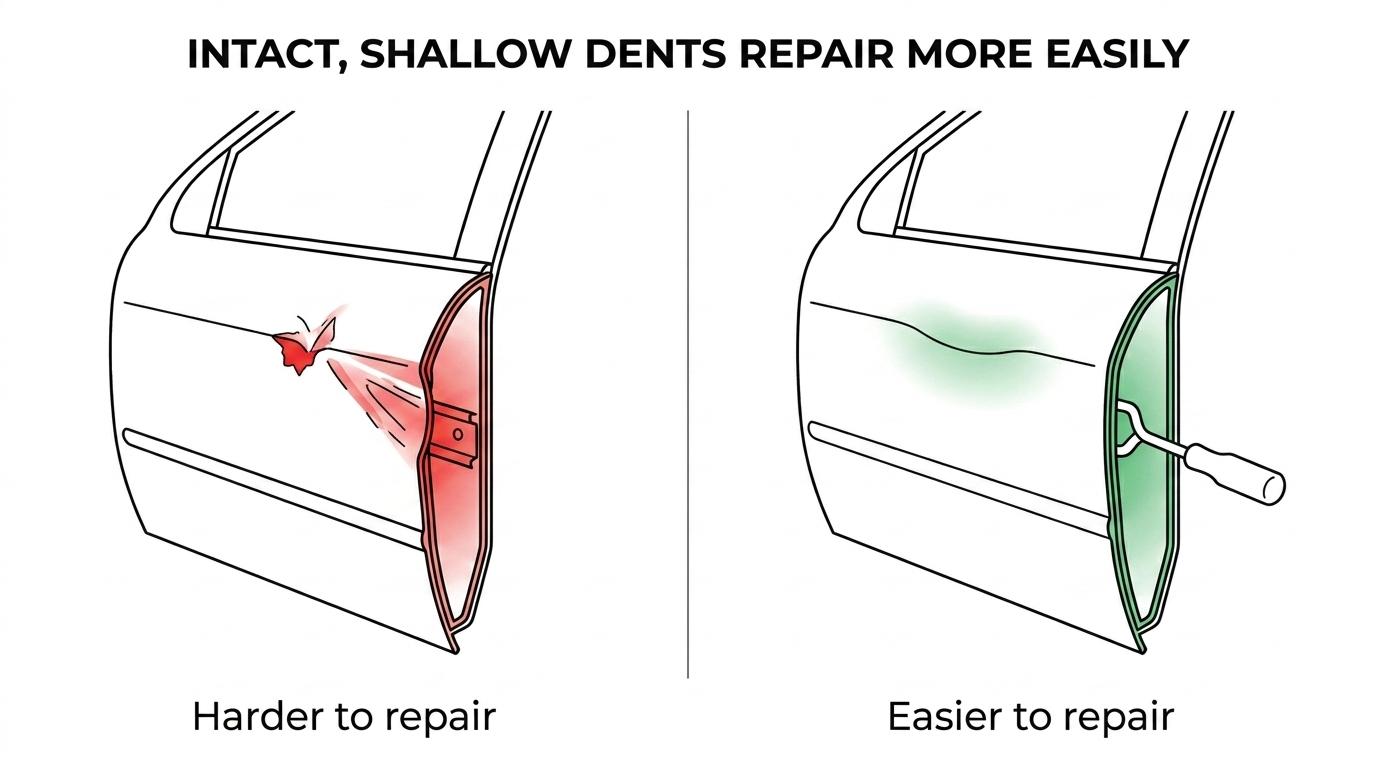
A common misconception is that PDR is only for tiny dings. In reality, some larger dents can still qualify if the paint is intact and the panel was not sharply creased. The reverse is also true: a small crease at the edge of a door can be a poor PDR candidate.
How do technicians decide whether a door dent is repairable?
Technicians decide by checking paint condition, metal memory, and backside access before choosing a repair path. At EZ Tech Paintless Dent Removal & Collision, that kind of assessment centers on whether the dent can be moved without cracking paint or whether the panel needs conventional repair.
The first question is finish integrity. If the factory finish is still bonded and flexible, PDR stays on the table. If paint is fractured or flaking, the panel may need filling, sanding, and refinishing after the metal work.
The next question is metal behavior. If the impact made a soft depression, the metal may still have enough memory to return. If it produced a tight panel crease or stretched the surface, the repair gets harder. This is why “small” and “easy” are not the same thing.

The last question is tool access. If a technician can reach the backside, repair choices expand. If a brace or window channel blocks blocked backside access, glue-pulling or conventional methods may be needed. If access is poor and the paint is already damaged, then full body repair often makes more sense than forcing a PDR attempt.
What damage conditions make a car door dent harder to fix?
Sharp creases, broken paint, blocked backside access, and stretched metal make door dents harder to fix. AAA specifically notes that PDR is limited when the dent is too large, inaccessible, creased, paint-damaged, or stretched beyond the metal’s memory point.
These limits matter because they explain why two dents that look similar in photos can receive different repair recommendations. A dent near the center of a flat door skin is very different from one folded into an edge or body line.
Technicians usually watch for a short list of problem conditions:
- Broken paint: Chips, cracks, or exposed metal often push the repair toward refinishing.
- Sharp panel crease: A crease concentrates impact force and can permanently stretch the panel.
- Blocked backside access: Door braces and internal components can stop tools from reaching the dent.
- Edge or body-line location: Dents near reinforced areas are tougher to reshape cleanly.
If a dent has two or more of those conditions at once, repair complexity rises fast. That does not always mean the door must be replaced, but it usually means a longer and more technical process.
When should you get a car door dent checked before it worsens?
You should get a door dent checked quickly when paint is chipped, metal is exposed, or the dent sits on a crease or edge. Consumer Reports notes that some scratches and dings are less noticeable if handled before they worsen.
Early evaluation matters most when the damage broke the finish. Once bare metal is exposed, moisture can start corrosion, especially in regions with road salt and winter slush. A dent near the lower door edge deserves extra attention for that reason.
Speed also helps with repair options. If the paint is still intact now, delaying may not help and could make the panel harder to restore if corrosion or secondary damage shows up. If the dent happened during a hailstorm, getting it documented promptly also helps separate fresh weather damage from older wear.
A practical rule is simple: if the dent catches light sharply, chipped the paint, or changed how the door edge looks, get it inspected. If it is a soft round ding with no paint damage, you may still have a strong chance of a cleaner, less invasive repair.