Roof dents are tricky because the roof skin is broad, thin, and often hard to reach from behind. EZ Tech Paintless Dent Removal & Collision, a Chicago-area collision repair and paintless dent repair shop, deals with the same decision point described by manufacturers and PDR authorities: the best fix depends on paint condition, dent severity, and backside access more than dent size alone.
TL;DR: Summary
- The best roof dent repair is usually paintless dent repair when the factory paint is intact, the metal is not sharply stretched, and backside access is reasonable; EZ Tech and sources like GM and NAPDRT describe those same core criteria.
- Cracked paint, deep stretch, sharp creases in contoured areas, edge damage, and zero-clearance access problems often push a roof dent toward conventional body repair or, in severe cases, replacement.
- Dent size matters less than many drivers assume. Some larger dents can still be repaired without paint, while some small sharp dents cannot.
- Roof dents often require checking the headliner, braces, roof rails, glass proximity, sunroof components, wiring, and airbags before choosing PDR, glue pulling, or refinishing.
- If the finish is intact and the panel is reachable, PDR can be much faster and cheaper than conventional repair while preserving the factory finish.
That is why two roof dents that look similar from the outside can require very different repair paths. If you want the shortest route to the right answer, start with a paint check, then judge metal stretch, then confirm how the technician can actually reach the damaged area.
What is the best repair option for a roof dent?
The best roof dent repair is usually paintless dent repair when the paint is intact, the metal is not sharply stretched, and the backside of the roof skin is reasonably accessible. GM and NAPDRT use those same practical criteria in different forms.
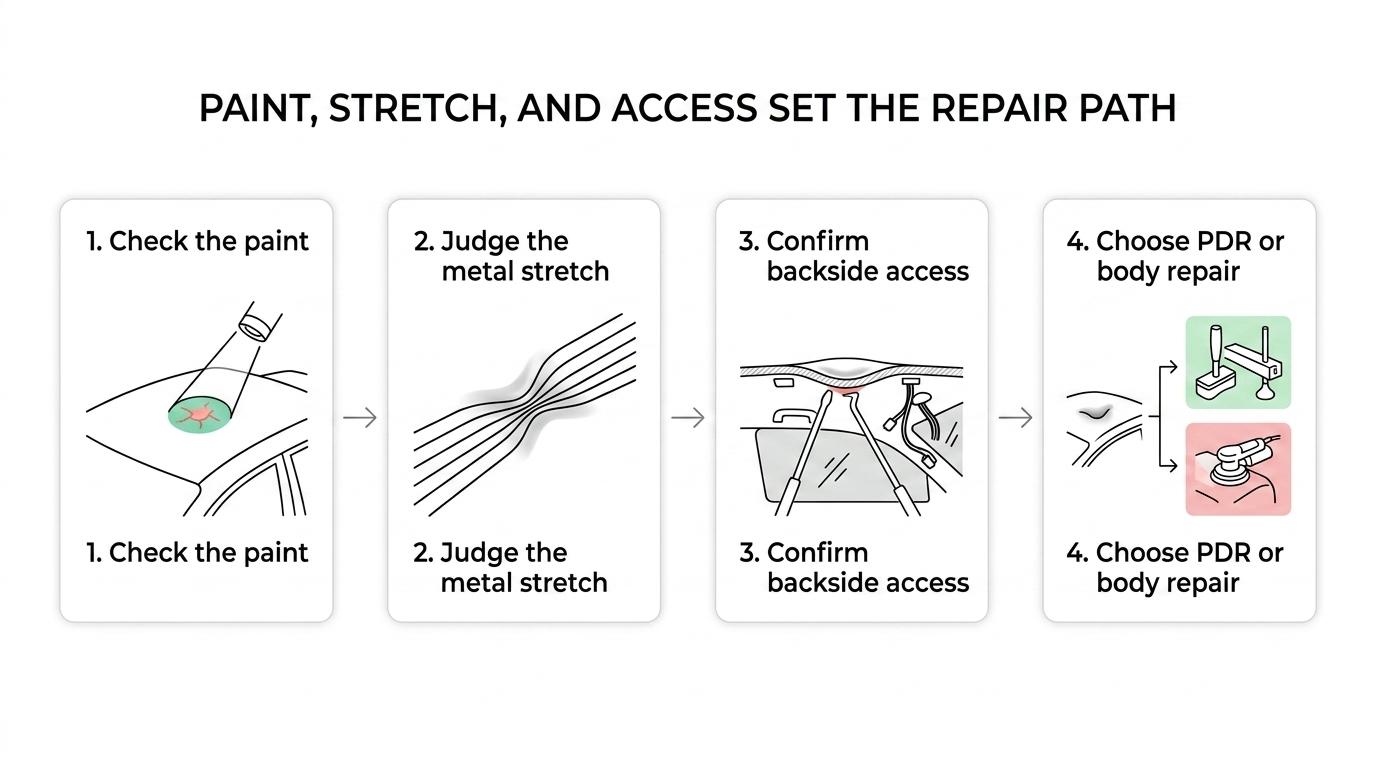
A roof panel behaves differently from a door or fender. It has wide, low-curvature sections, internal braces, trim, and sometimes a sunroof cassette, curtain airbags, or wiring that affect access. According to NAPDRT, PDR removes dents without removing paint by massaging the damaged area from the back of the panel, and GM’s repair guidance says it is appropriate when paint is unbroken and access is reasonable.
“EZ Tech says most roof dents can be fixed in 2 to 4 hours when PDR is the right method.”
A common mistake is judging the repair only by diameter. A shallow 4-inch roof dent with healthy paint may be a better PDR candidate than a 1-inch sharp dent that split the clearcoat or pinched a roof edge. If paint is broken or the metal is severely stretched, conventional repair becomes more likely.
When does paintless dent repair work on a roof dent?
EZ Tech and GM both treat roof dents as good PDR candidates when factory paint is unbroken and tool or glue access is realistic. If either condition fails, the odds of a paint-preserving repair drop fast.
The core PDR checklist is simple. First, the finish should still be intact. Second, the metal should not show a sharp center point, deep stretch, or torn edge. Third, the technician needs a workable path to move the metal, either from behind or with controlled glue pulling where that method is appropriate.
GM specifically flags several poor PDR candidates: cracked paint, dents that require drilled holes, sharp dents in contoured areas, edge dents, and zero-clearance spots where glue-stick dent removal fails. NAPDRT makes a similar consumer-facing point by noting that cracked paint, very deep dents, or poor locations can make PDR unsuitable.
The term “reasonable access to the back side” matters on roof panels because access can vary a lot. A simple hail dent in the middle of a roof may be approachable after trim and headliner work. A dent beside stationary glass or tight against a roof rail may depend more on glue pulling or may need conventional refinishing.
What roof dent repair options are the most common?
There are four main roof dent repair paths: backside PDR, glue pulling, conventional body repair with paint, and panel replacement. The right one depends on damage shape, finish condition, and access, not on which method sounds cheapest at first.
Before you compare estimates, make sure each shop is talking about the same method. One estimate might assume full refinish, while another assumes pure PDR. Those are not apples-to-apples quotes.
- Backside paintless dent repair: Specialized rods and picks move the metal from behind the roof skin. This is usually the top choice when paint is intact and access is possible.
- Glue pulling: External tabs pull the dent outward without sanding or filler. This is often useful near roof rails or glass where backside tool clearance is limited.
- Conventional body repair: The panel is reshaped, filled as needed, sanded, primed, and repainted. This is common when paint is cracked or the metal is too stretched for a paint-preserving repair.
- Roof panel replacement: This is reserved for severe damage, tears, major structural involvement, or cases where repair would not meet quality or safety expectations.
How do you inspect paint condition before choosing a repair?
Paint condition is the first gate. On a Ford or Tesla roof, intact clearcoat usually keeps PDR in play, while cracked paint often pushes the repair toward refinishing.
Start with a clean panel. Dirt hides fractures, chips, and tiny lifted edges. Then inspect the dent under direct light and a low-angle reflection. What looks like a smooth ding in shade can reveal a sharp center or split clearcoat under stronger light.
Next, look at the center of the dent and the high spots around it, sometimes called crowns. Tiny cracks or chips at those points matter more than many drivers expect because they show the finish has already failed as the metal moved.
“EZ Tech describes roof-dent PDR as a repair that avoids fillers, sanding, and repainting when the factory finish is still intact.”
Last, run a fingertip lightly across the area. If the paint feels broken, lifted, or rough at the impact point, plan for the possibility that PDR alone is not enough. A common misconception is that “just a hairline crack” is cosmetic only. On a roof, even a small break can expose bare metal and change the repair path.
How do you check dent depth and metal stretch?
Dent depth and stretch tell you more than width. A shallow Honda roof dent may stay within PDR limits, while a small sharp crease can exceed them.
First, use reflected light to read the shape, not just the outline. Straight reflection lines that bend gently usually point to a softer dent. A tight V-shape, knife-edge crease, or concentrated low spot suggests deeper stretch. Pro tip: a reflection board or even overhead fluorescent lines can reveal distortion that photos flatten out.
Second, feel for rigidity changes around the impact. If the metal feels loose, unstable, or “oil cans” when pressed, the roof skin may be stretched beyond what a clean PDR finish can control. That does not always mean replacement, but it often means conventional repair.
Third, connect the dent shape to the paint signal. NAPDRT notes that cracked paint can indicate a dent is too deep. If the dent is shallow and the finish is sound, PDR stays likely. If the dent is sharp and the paint is fractured, refinishing moves up the list quickly.
How do you judge access behind the roof panel?
EZ Tech and GM both treat backside access as a deciding factor, because a good-looking dent can still be a poor PDR candidate if the roof skin sits behind braces, airbags, wiring, or a sunroof assembly.
Start with the panel layout. Roof skins often have internal bows, braces, adhesive sections, and trim anchors. Then add real-world obstacles: headliners, dome lights, roof consoles, shark-fin wiring, curtain airbags, and glass edges. Each one affects whether a tool can reach the exact low spot at the right angle.
GM’s bulletin is useful here because it draws a hard line around bad access scenarios. If PDR would require drilled holes, structural part removal, or work in zero-clearance areas where glue removal fails, that is a strong sign conventional repair may be the better path.
Do not assume a sunroof automatically rules out PDR. Sometimes the opening helps with access; sometimes the cassette blocks it completely. If access is partial, a technician may blend methods, using backside tool work where possible and glue pulling in tighter zones.
Is PDR better than conventional body repair for a roof dent?
PDR is better for many roof dents when the paint is intact because it preserves factory finish, avoids filler, and usually shortens repair time. Conventional repair is better when finish damage, sharp deformation, or access problems make a paint-preserving result unrealistic.
The biggest advantage of PDR is originality. Factory paint is generally the benchmark for color match, texture, and long-term value retention. A roof panel is also visually broad, so avoiding a refinish can matter more than on smaller panels. NAPDRT says PDR often costs one-quarter to one-third of conventional dent repair, though roof complexity can shift that range.
The trade-off is that PDR is less forgiving when the metal has been pushed too far. Conventional repair can handle cracked paint, deeper stretch, and shapes that cannot be returned cleanly by metal movement alone. If your priority is preserving original paint and the dent qualifies, PDR usually wins. If your priority is restoring a severely damaged roof to proper shape regardless of repainting, conventional work may be the correct choice.
Is glue pulling or backside tool work better on a roof?
Neither method is always better. Backside tool work offers the most direct metal control, while glue pulling is often better near roof rails, braces, and glass where rod access is limited.
On roofs, glue pulling is commonly discussed around tight spaces because it does not require direct backside contact with every low area. GM notes glue-stick dent removal is commonly used on roof rails and roof skin near stationary glass. That said, glue pulling depends on strong paint adhesion and the right tab placement. If the paint is weak, the risk changes.
“EZ Tech says roof dent repairs can save 50% to 70% compared with traditional body shops.”
Backside tool work gives a technician precise pushes and finer finishing control, especially on softer dents. The trade-off is access time. If the headliner and trim work are significant, labor can climb even when PDR remains the right repair. The best roof results often come from choosing the method the panel allows, not forcing one favorite technique.
Can a large roof dent still be repaired without paint?
Yes, a large roof dent can sometimes be repaired without paint if the finish is intact and the metal is not sharply stretched. GM makes clear that size alone is not the only cutoff, even though some dents over 3 inches may still need conventional paint repair.
This is one of the biggest misconceptions in roof dent repair. Drivers often assume “large equals body shop” and “small equals PDR.” In practice, a broad shallow dent can be a strong PDR candidate, while a tiny impact near a contour or edge can fail the test immediately.
If the dent has soft edges, no paint break, and good access, PDR may still be viable even at a larger diameter. If the dent has a hard center, crowns that locked the metal, or lives in a contour near a roof rail, the odds shift the other way. If-then logic helps here: if the metal moved wide and smooth, think PDR first; if it moved tight and sharp, think refinishing first.
What signs mean a roof dent needs conventional repair or replacement?
Certain signs strongly point away from PDR. Cracked paint, torn metal, severe stretch, and blocked access are the most common reasons a roof dent moves into conventional repair or replacement.
After the basic inspection, look for these decision markers:
- Cracked paint: The finish has failed, so paint-preserving repair is no longer the whole answer.
- Sharp crease or pointed impact: Deep concentrated damage usually means stretched metal and harder finishing.
- Edge or roof rail distortion: Tight contours and pinched edges are harder to correct cleanly with PDR.
- Blocked backside access: Braces, zero-clearance zones, or required structural disassembly can take PDR off the table.
- Torn metal or structural involvement: Severe damage may require conventional repair or panel replacement to restore proper condition.
One more misconception is worth clearing up: replacement is not the default just because the dent is on the roof. Replacement is usually reserved for the most severe cases, not routine dings, hail strikes, or broad non-structural dents.
How fast and how expensive is roof dent repair?
Roof dent repair is often faster and cheaper with PDR, but real timing depends on access work as much as the dent itself. A simple hail ding and a brace-blocked roof crease may have very different labor needs.
NAPDRT says many dents can be fixed in less than an hour and that PDR typically costs one-quarter to one-third of conventional dent repair. Roof dents, though, often take longer than door dings because headliner access and finishing time matter. That is why photo-only estimates can be directionally helpful but still change after an in-person inspection.
EZ Tech says many roof dents can be repaired in 2 to 4 hours and that roof-dent PDR can save 50% to 70% compared with traditional body-shop methods when the dent qualifies for paintless repair. That lines up with the broader pattern in the industry: PDR is often the lowest-cost path when paint is intact, but once refinishing, filler work, or replacement enters the picture, the economics change fast.
If you are comparing quotes, ask one simple question: “Is this estimate based on PDR, glue pulling, conventional repair, or replacement?” That single detail explains a lot of price gaps.