Many drivers assume hail damage means sanding, filler, and a full repaint. That is not always true. A large share of hail dents can be repaired while keeping the original paint intact, which is exactly why paintless dent repair, or PDR, is so widely used after storms.
The short answer is yes: hail dents can often be removed without paint. The deciding factors are usually the condition of the paint, the shape of the dent, and whether a technician has access to the backside of the panel. If those three things line up, the factory finish can often stay right where it is.
How hail dents are removed without repainting
Paintless dent repair is a method used to reshape damaged metal without sanding off the finish or spraying new paint. According to State Farm’s hail damage guide, PDR removes hail dents from exterior metal panels without disturbing the vehicle’s finish. The process usually involves specialized tools that gently push from the backside of the panel, though some dents can also be worked from the outside depending on size and location.
That matters because factory paint is usually the best paint a vehicle will ever have. When a repair can preserve it, the result often looks more original, and the repair process can be faster than conventional body work. Many car owners care about that, especially when the damage is spread across a hood, roof, or trunk but the paint surface is still smooth and unbroken.
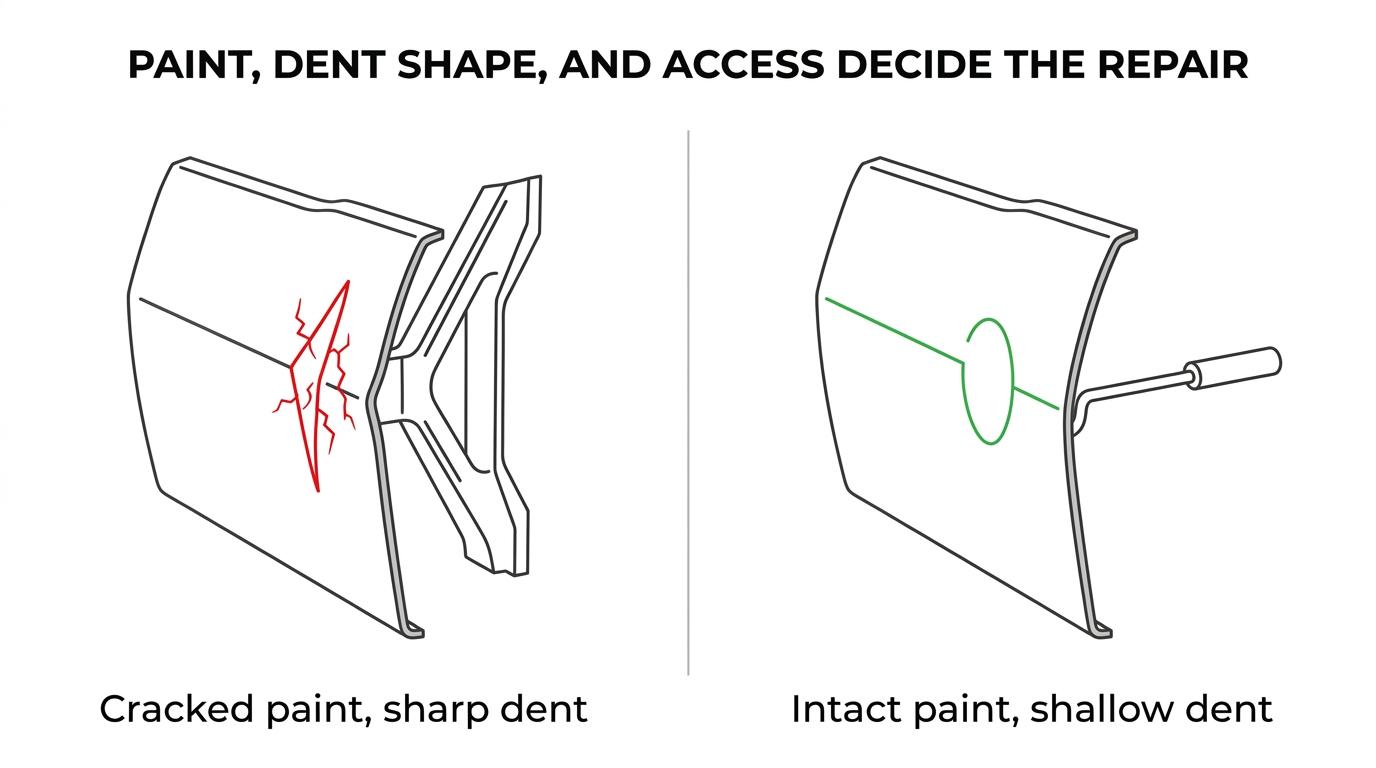
A quick rule helps: if the hail dent is shallow and the paint is intact, PDR may be an option.
When paintless dent repair works for hail damage
PDR is not limited to one or two tiny dents. A vehicle can have dozens, or even hundreds, of hail marks and still qualify for paintless repair if the metal can be reshaped cleanly and the finish has not been broken.
That is why inspections matter more than assumptions. A car may look heavily damaged from across the parking lot, but once proper lighting is used, a technician can sort the dents into repairable and non-repairable areas. In many cases, the roof, hood, trunk lid, and upper door sections are all candidates for non-paint repair.
Common signs that hail damage may be a good fit for PDR include:
- Intact factory paint
- Shallow, rounded dents
- No sharp creases
- Metal that has not been stretched too far
- Reasonable access behind the damaged area
- Damage away from panel edges and reinforcements
A recent article on when hail damage needs paint work explains the same basic standard in plain terms: smooth, unbroken paint and workable dent shapes usually point toward PDR, while broken finish and sharper damage tend to shift the repair toward refinishing.
When hail damage needs conventional body repair and paint
Not every hail dent can be removed without paint. Once the impact damages the finish or changes the metal too sharply, the repair path changes.
Cracked paint is one of the biggest signs. If the surface is split, chipped, or lifting, the panel no longer has a sealed finish. Even if the metal could be moved back into shape, the damaged coating would still need to be repaired. In that situation, body work and repainting are often necessary to restore appearance and corrosion protection.
Sharp creases are another issue. Hail usually causes round dents, but larger stones or unusual impact angles can create harder lines. Those dents put more stress into the metal and can leave a visible line even after reshaping. Edges are also tricky. Damage near the lip of a hood, roof rail, or body line is harder to correct because the metal is tighter and access is more limited.
A GM service bulletin on “dented no paint damage” supports this same distinction. PDR is suited to dents with no paint damage and reasonable access to the backside of the panel, but not to panels with cracked paint or repairs that would require drilling holes or removing structural parts.
PDR vs. conventional hail repair
The difference between these two paths is easier to see side by side.
| Repair factor | Paintless dent repair | Conventional repair and paint |
|---|---|---|
| Paint condition | Paint remains intact | Paint is cracked, chipped, or missing |
| Dent shape | Usually shallow and smooth | Often sharp, stretched, or creased |
| Panel access | Backside access is available | Access is blocked or too limited |
| Repair method | Metal is massaged back into shape | Filler, sanding, primer, and repainting |
| Factory finish | Preserved | Refinished |
| Best use case | Dented no paint damage | Damage that includes finish failure |
The table is simple, but it captures the core issue. Hail dents are not judged only by how many there are. They are judged by whether the original finish can stay in place while the metal is restored.
Paint condition, dent shape, and panel access inspection
A proper hail inspection usually starts under dedicated lights. Those lights make tiny distortions in the reflection easy to see, which helps map the full extent of the damage. Some dents that are nearly invisible in daylight stand out right away under shop lighting.
After that, the technician checks three main things:
- Paint condition: Is the finish still smooth, bonded, and unbroken?
- Dent shape: Is the dent soft and round, or sharp and creased?
- Panel access: Can tools reach the backside of the panel without improper disassembly or drilling?
Those points sound simple, yet they decide nearly everything. A hood with fifty small dents may still be a better PDR candidate than a single hail strike that chipped paint on a sharp body line.
Access is often the part drivers do not think about. Roof braces, double-wall construction, glued reinforcements, and tight body lines can block tool placement. Sometimes access can be gained by removing trim, headliners, or inner panels. Sometimes it cannot be done safely or efficiently. That is when a panel may need a different repair plan.
Can severe hail damage still be fixed without paint?
Yes, severe-looking hail damage can still qualify for paintless repair.
The number of dents alone does not decide whether paint is needed.
A storm can pepper a vehicle with damage across multiple panels, and if the impacts are mostly shallow and the finish is still intact, PDR may still handle the bulk of the work. This is one reason hail repair often surprises people. A car that looks rough at first glance may not need the amount of repainting the owner expects.
What matters more is the type of damage than the volume of damage. Hundreds of small roof and hood dents with intact paint can be repairable through PDR, while a smaller cluster of dents with cracked paint near panel edges may need traditional body work.
There are also mixed repairs. One vehicle may get PDR on the roof and hood, while a chipped fender or sharply creased deck lid gets refinished. Hail claims do not always fall into one clean category.
Insurance coverage for hail dents and repair timing
Insurance questions come up right away after a storm, and for good reason. State Farm notes that comprehensive coverage is the coverage type designed to help cover hail damage to a car. That does not mean every policy handles every situation the same way, so it is smart to review your deductible, claim process, and any inspection requirements.
Timing matters, too. Hail dents do not usually make a car unsafe to drive by themselves, but waiting too long can complicate things. New dents become harder to separate from old ones, photos get lost, and repair scheduling can fill up fast after a major local storm. Quick documentation helps.
A practical post-storm checklist can keep things organized:
- Take clear photos of the roof, hood, trunk, glass, and side panels.
- Check for cracked paint, chipped edges, and broken trim.
- Contact your insurer if you carry comprehensive coverage.
- Schedule a professional hail inspection before minor damage is overlooked.
- Ask whether the repair can preserve the original finish.
Why the factory finish matters in hail dent repair
Keeping the factory finish is not just about appearance. Original paint usually has the best consistency in texture, color, and long-term durability across the vehicle. When a panel can be repaired without disturbing that finish, owners often avoid the extra steps that come with refinishing.
That may include:
- Color match concerns: especially on metallic and pearl finishes
- Extra repair stages: filler, primer, paint, and curing time
- Rental days
- More time in the shop
- A broader repair footprint
This is why so many hail inspections start with the same question: can the dents be removed while leaving the paint alone? If the answer is yes, that route is often attractive from both a cosmetic and time standpoint.
What drivers around Chicago should do after a hailstorm
Chicago-area weather can turn quickly, and spring through late summer storms can leave vehicles with roof, hood, and trunk damage before owners have time to move under cover. If hail hits, it helps to wash off loose debris, inspect the car in good light, and avoid pressing on dents yourself. DIY pressure can make the metal shape worse, and suction tools sold online rarely address hail damage cleanly.
A local inspection is useful because regional storm volume affects repair timelines. After a widespread hail event in places like Naperville, Glen Ellyn, Downers Grove, or across the larger Chicago area, repair scheduling can fill up fast after a major local storm. Early estimates also give owners a better chance to decide whether the damage is a straight PDR job or a mix of PDR and conventional repair.
The key point stays the same no matter where the storm happened: hail dents can often be removed without repainting, but only when the paint is intact, the dent shape is workable, and there is good access to the panel from behind.
If the surface still looks smooth and unbroken, there is a good chance the original finish can be saved.